
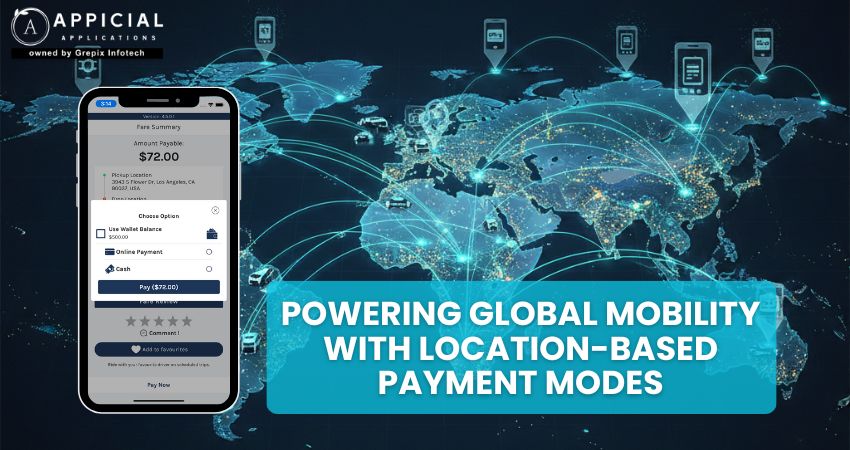
Powering Global Mobility With Location-Based Payment Modes
Mobility on a global scale is undergoing a new phase of change, with locational forms of payment at the center of this shift. Urban growth shows no sign of abating, and by 2030, more than 60 per cent of humanity will be residing in cities, likely leading to greater demand for quick and flexible transport systems. Convenience is of high priority for the modern user, who expects quick and easy payments, clear pricing and bills, and hassle-free rides and apps in ride-hailing platforms. Here the digital mobility ecosystems are moving beyond traditional manual fare and are using intelligent automated billing processes that change based on the users live location, route, and destination.
Location-based payment methods enable the rider to pay in real-time for kilometers traveled, zone pricing, toll zone, cross border fee, waiting period, and surge pricing. This model integrates perfectly within a contemporary mobility network based on Uber Clone technology, an advanced Ride-sharing app or a scalable white-label taxi booking app. These platforms allow payments to be processed automatically based on GPS signals, trip meters, and system-generated invoicing without friction.
The rise of location-aware financial transactions is also encouraging global transportation companies to collaborate with a skilled white label taxi app development company, as scalable software architecture now requires precision, automation, and intelligent fare systems.
The objective is simple: to accelerate global mobility through smart payments that operate within the user’s physical environment, adapt to distance-based pricing, and deliver unmatched convenience.
This comprehensive guide explains how global mobility is rapidly evolving through location-based payment modes. The article embeds a discussion of the localizing infrastructure of transactions that make these gains in accessibility, speed, fare calculation, fraud detection, driver efficiency, and cross-border scalability possible in the ride-hailing ecosystems. It also lives the role of digital wallets, geo-intelligent billing algorithms, and integrated fare automation in providing a seamless travel experience across continents. The conclusion promotes Appicial Applications as a leading expert in white label taxi app development and global taxi-tech innovation.
Why Are Location-Based Payment Systems Transforming Mobility?
Location-powered payment structures solve long-standing challenges that legacy transport models couldn’t overcome. Traditional cash-based rides depend heavily on driver calculations, manual fare meters, and region-based bargaining. This leads to slow settlement, price disputes, uncertainty, payment decline, and poor user retention. GPS-driven payments address these challenges with accuracy, transparency, security, and automatically generated receipts.
In modern mobility ecosystems, algorithms simplify fare mapping across cities, inter-state zones, airport charging lanes, peak time surges, and geo-restricted toll routes. For companies adopting Uber Clone solutions or scaling a Ride-sharing app, location-driven pricing ensures every fare is fair, verified, and algorithmically justified. Riders no longer guess prices, they view live cost breakdowns inside their white-label taxi booking app interface with complete clarity.
This technology is advancing because machine-calculated billing increases trust, reduces operational delays, and improves business scalability. Fleet operators prefer automated payments because they eliminate revenue leakage, ensure driver payouts, and maintain zone-wise earnings without paperwork. These advantages are also why global startups collaborate with an experienced taxi app development company, ensuring their systems support GPS-linked billing and global wallet integrations.
How Do Location-Based Payments Work Inside a Ride-Hailing System?
Location tracking connects riders, drivers, and payment gateways into a synchronized billing environment. GPS analytics calculate fares based on distance, speed, route complexity, real-time congestion levels, and dynamic pricing models. A Ride-sharing app or Uber Clone framework integrates geofencing to detect accurate pickup zones and drop-off coordinates.
Once a trip begins, the white-label taxi booking app continuously updates distance traveled and generates live fare values. If road diversions are taken, pricing updates automatically. If a trip crosses municipal borders, toll fee addition is automated. If congestion slows movement, idle pricing is added. At trip completion, the invoice is instantly generated, and riders can pay through wallet balance, card, UPI, or region-specific digital payment tools, depending on their geographic location.
With location-aware billing, drivers no longer negotiate, riders do not wait for calculations, and transport providers eliminate human errors. Thus, mobility becomes faster, transparent, and efficient.
What Benefits Do Location-Driven Payments Provide for Global Ride-Hailing?
Location-based payments offer direct financial benefits for riders, drivers, and fleet owners. They increase operational transparency and support global expansion. Below are the most meaningful benefits:
- Reduced payment friction and instant settlementUsers complete payments instantly without negotiation. This eliminates dispute risks, accelerates trip completion, and boosts satisfaction.
- Improved transparency and standardized fare billingRiders understand how much they pay and why. With automated pricing inside an Uber Clone or Ride-sharing app, every charge is algorithm-based.
- Higher operational efficiency for transportation fleetsDrivers focus solely on completing trips instead of calculating fares. Owners reduce revenue leakage caused by manual rounding or miscalculation.
- Scalable adoption across global travel zonesMobility companies can expand internationally as location-wise financial models work across countries, cities, and airports.
- Fraud prevention and digital audit trailPlatform-based billing generates tracked payment history, preventing unreported rides and under-declared driver revenue.
These benefits encourage companies to collaborate with a skilled white label taxi app development company or taxi app development company to integrate geo-intelligent payments inside future mobility products.
How Do Global Platforms Use Location-Based Payment Systems for Revenue Growth?
Mobility operators use GPS-driven billing to boost average revenue per user, reduce operational cost, and retain long-term users. Surge pricing during high-traffic periods increases revenue, while geofencing helps categorize peak zones. If a company scales with an Uber Clone or Ride-sharing app, dynamic pricing can increase platform earnings by 18-32% compared to static fare models.
Real-time distance billing and digital wallet integration also reduce cancellation issues, as riders already view cost breakdowns before confirming rides. Transparent pricing builds user trust, increasing repeat bookings up to 40% in digitally-optimized markets.
Growth accelerates when a mobility company integrates location-tracking solutions through an expert taxi app development company specializing in automation. As per industry data, ride-hailing payments processed via mobile wallets are expected to surpass $1.3 trillion by 2028, proving that digital travel payments are the core future of mobility.
Is Location-Based Payment Integration Essential for Uber Clone-Based Startups?
Yes. A modern ride-tech startup will struggle in global markets without geospatial billing. Users expect ride cost accuracy, instant checkout, and cashless travel. Without these functionalities, market competition becomes extremely challenging, especially when competing with advanced fleets that already use intelligent pricing.
An Uber Clone with integrated location-based billing provides strong market differentiation. A white-label taxi booking app with automated billing attracts global riders who want simplicity and trust while traveling. The implementation of intelligent pricing also helps startups regulate driver payout cycles, vendor settlements, and multi-region fleet calculations.
Thus, bypassing location-based payment logic in mobility systems reduces scalability and affects user adoption. Partnering with a white label taxi app development company ensures implementation with accuracy, compliance, and world-class stability.
Learn More: How POS Integration Is Transforming Ride Booking and Payments in Taxi Apps
Why Should a Mobility Startup Invest in a White-Label Taxi Booking App With Smart Payments?
The white-label taxi booking app is customizable, ready to go, and quick to deploy for any size mobility company, from a startup to a large enterprise. Coupled with location-based payment, it obviates the longest phase of ride-hailing tech evolution, fare system architecture.
It can also integrate region-based tax rules, QR fare payments, multi-currency wallets, contactless card payments, promo-based distance pricing and subscription billing as a scalable white label platform. These are crucial for long-term operation and expansion into new countries or metropolitan markets where price sensitivity is high.
Look for a taxi app development company with an international background that will ensure smooth deployment and compliance, local policies, GPS-metering, and scalability for future needs. Instead of starting from scratch, startups spin up faster, engineering cost goes down and monetization happens sooner.
Conclusion
Mobility is evolving every day. Payment automation with location-based, ride hailing is seamless, transparent and globally scalable. Smart billing models help growth, can enhance the revenue cycle, foster trust and reduce disputes and allow for rapid completion of trips. In order for an innovative Uber Clone or current version of our Ride-sharing app or even a customizable white-label taxi booking application to stay competitive in the international transportation market, it must incorporate terrain-aware transactions.
If you are planning to launch a scalable ride-hailing startup, you need the right development partner. Appicial Applications, a leading white label taxi app development company and global taxi app development company, builds future-ready software powered with GPS billing, automation, advanced route logic, multi-currency wallet integration, and AI-ready architecture.
Bring your ride-hailing vision to life- connect with Appicial Applications today and build the future of mobility.
FAQs
Author's Bio

Vinay Jain is the Founder at Grepix Infotech and brings over 12 years of entrepreneurial experience. His focus revolves around software & business development and customer satisfaction.
Back to blog list