
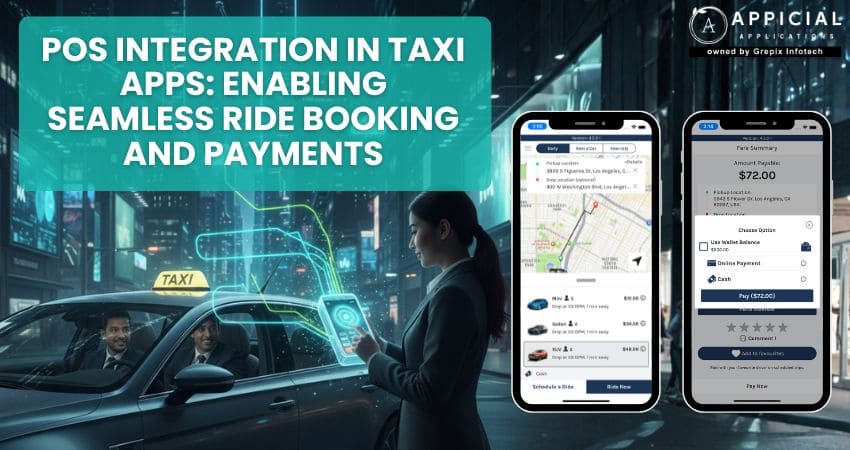
POS Integration in Taxi Apps: Enabling Seamless Ride Booking and Payments
A modern ride-hailing ecosystem demands speed, transparency, and cash-free convenience. The evolution of digital transportation has shifted user preference toward rapid bookings, secure payment processing, and data-driven ride management. POS integration has become a defining technical feature for taxi apps across global markets. This mechanism links backend billing, passenger payment activity, driver settlements, and real-time transaction logs into one cohesive structure.
With ride-hailing usage estimated to surpass 1.45 billion global users by 2027 (Statista), taxi operators require stronger automation within their booking workflows. POS integration fulfills this requirement by bridging payment terminals, wallets, cards, and third-party gateways directly with ride-booking software.
Businesses developing a Ride-sharing app or launching an Uber Clone observe that POS adds operational reliability. It reduces cash handling dependency and promotes digital adoption. A white-label taxi booking app equipped with centralized POS supports in-car payments, pre-ride billing, and automated instant fare deductions. These advantages deliver convenience to both passengers and drivers, while strengthening compliance, accounting, and revenue governance.
The objective of this blog is to deliver an in-depth exploration of the value, structure, implementation process, challenges, features, and enterprise scalability associated with POS integration in taxi applications.
Below is an extensive breakdown of all essential components.
This in-depth blog explains how POS integration enhances payment functionality in taxi applications. It covers architecture, business benefits, technical features, challenges, and future trends of POS within modern ride-hailing platforms. With digital transactions growing rapidly, integrating POS into an Uber Clone, Ride-sharing app, or white-label taxi booking app increases efficiency, reduces payment friction, and builds a scalable mobility ecosystem.
Why Is POS Integration Essential for Modern Taxi Apps?
POS integration streamlines ride-booking transactions by eliminating friction from the payment cycle. Riders no longer face issues related to loose change, denied cards, or bank processing delays. With digital payments growing by more than 16.7% annually worldwide, taxi businesses must enable multi-channel payment flexibility. A Ride-sharing app must meet expectations for instant billing clearance. An Uber Clone requires the resiliency to handle thousands of micro-transactions per minute globally. POS supports these large-scale financial operations efficiently.
A white label taxi app development company making enterprise mobility solutions embeds payment APIs that connect gateways, wallets, and POS terminals. The integration automates every fare calculation and stores transaction logs for audits. Taxi operators gain financial visibility across all trips. POS also strengthens application functionality by improving bookings per minute capacity. Faster payments reduce trip delays, which increases driver earnings and overall market supply availability.
How Does POS Integration Work Within Taxi Application Architecture?
The mechanism sits between the booking server and payment network. When a rider confirms a booking, the app locks the fare estimate. After trip completion, mileage and waiting time are calculated automatically. The user receives a bill breakdown and selects payment mode. POS then generates a secure request, encrypts card/wallet details, and processes the amount through the configured gateway.
Once approved, payment confirmation updates both passenger and driver dashboards. Tips, tolls, and surge charges also settle instantly. Whether it's a white-label taxi booking app or an Uber Clone, this workflow remains the same. A well-engineered POS system integrates with:
- In-car card terminals
- Mobile wallet platforms
- Bank APIs
- Corporate billing accounts
- QR-based instant payment systems
The role of a taxi app development company is to design robust middleware that syncs billing nodes with live ride status. This prevents billing errors, reduces manual interventions, and supports round-the-clock financial monitoring.
What Are the Business Benefits of POS-Powered Taxi Applications?
Businesses launching a Ride-sharing app must differentiate themselves. POS integration works as a competitive edge because it enhances both experience consistency and financial scalability. The benefits extend across stakeholders.
Passenger Advantages
Customers expect convenience. POS eliminates manual fare disputes. Trips complete faster because payments auto-settle. Refunds and cancellations process without paperwork. Frequent riders can save cards for one-click checkout. App loyalty strengthens because users trust payment transparency.
Driver and Fleet Advantages
Drivers avoid handling cash. Daily earnings reflect instantly on their wallets. Commissions deduct automatically, removing end-shift payment queues. Fleet owners see revenue insights in a structured dashboard tied to POS logs. An Uber Clone thrives when driver-experience friction is minimal.
Business Administration Advantages
POS facilitates revenue forecasting, taxation, and split payments. It strengthens compliance by generating verified financial reports. Audits become straightforward. A white label taxi app development company can integrate royalty, surge pricing, coupon management, and multi-currency acceptance under one billing engine. For enterprises, POS becomes a backbone for operational stability.
What are the Key Features Required for POS Integration in Taxi Apps?
To ensure reliability, the payment module should include several essential functions. A scalable Ride-sharing app must be equipped with every component listed below for smooth execution.
- Real-Time Fare Synchronization: Pricing updates post-ride completion without refresh delays. Surge multipliers apply automatically.
- Multi-Mode Payment Acceptance: POS must support corporate invoices, e-wallets, NFC, and cards. This increases ride conversion rates significantly.
- Advanced Fraud Detection Protocols: Chargeback triggers, suspicious refunds, and rapid transaction attempts are flagged through security layers.
- Payout Automation for Drivers: Earnings settle quickly. The POS backend splits platform commission before auto-disbursing driver payouts.
- Offline Transaction Handling: Even without network stability, billing completes and syncs later. A taxi app development company implements hybrid caching to support this.
These features reduce cash dependency and accelerate trip throughput. The more robust the POS module, the higher the platform trust score.
What are the Challenges When Integrating POS in a Taxi App and How to Overcome Them?
Complexity arises when scaling financial functions across regions. Multi-currency regulations, gateway downtime, server delays, and PCI-DSS compliance require strategic planning.
- Security and Data Protection: Handling card information requires encryption and tokenization. The POS must anonymize card details to prevent identity theft. Vendors must integrate firewall-grade protection and periodic pen-testing.
- API Compatibility Across Gateways: Some countries have unique financial systems. Gateways require localization patches. A skilled white label taxi app development company executes multi-region integration layers.
- Transaction Congestion During High-Volume Operations: Large ride networks generate intense billing activity. Load-balancing servers and distributed cloud architecture help maintain processing speed for Uber Clone solutions.
- Adoption Resistance from Cash-Preferred Riders: Taxi platforms must educate passengers about digital payment benefits. Offering promotional discounts, loyalty credits, and QR-scan payments increases digital uptake.
Businesses that successfully address these factors ensure friction-free POS performance.
Learn More: Location-Based Commissions: Why Taxi Apps Must Customize Driver Earnings
What are the Future Trends in POS Integration for the Ride-Hailing Sector?
POS systems are evolving alongside mobility platforms. AI-powered billing, voice-payment authorization, direct wearable payments, and biometric-verified wallets are entering mainstream adoption. Studies reveal that over 64% of global consumers prefer digital transport payments over cash. The next decade will witness interconnected POS networks where micro-transactions sync with government tax servers as well.
Meta-transactions, subscription-based travel accounts, fuel expense mapping, and machine-audited revenue breakdowns will also advance. A taxi app development company that adapts early will enable faster digital transition. With automation, businesses minimize human error, reduce fraud exposure, and accelerate revenue turnover.
Ride-sharing platforms are shifting toward ecosystem-based payment infrastructure. Instead of standalone billing nodes, POS will interact with fleet monitoring, driver rating analytics, EV-charging networks, and passenger identity verification. A scalable Ride-sharing app benefits from this connectivity because it supports broader service expansion into logistics, delivery, shuttle services, and corporate mobility.
Conclusion
POS integration is no longer optional in digital taxi management. It is a core strategic component that influences ride conversion, billing accuracy, and passenger satisfaction. Businesses adopting POS gain clear visibility into revenue structures, trip economics, and driver payouts. A high-performance Uber Clone or Ride-sharing app backed by intelligent POS creates a friction-free booking experience. It increases operational efficiency, reduces cash dependency, and makes mobility platforms future-ready. Enterprises investing in a white-label taxi booking app must ensure that their POS infrastructure remains scalable, secure, and globally compatible.
If you are planning to launch a highly scalable mobility solution, Appicial Applications is positioned to build it with unmatched technical precision. As a proven white label taxi app development company and an established taxi app development company, Appicial delivers enterprise-grade ride-hailing systems with built-in POS billing, automation-driven fare management, and friction-free payment processing. Connect now to modernize your fleet operations and deploy a globally competitive platform.
Book Your Consultation with Appicial Applications Today
FAQs
Author's Bio

Vinay Jain is the Founder at Grepix Infotech and brings over 12 years of entrepreneurial experience. His focus revolves around software & business development and customer satisfaction.
Back to blog list