
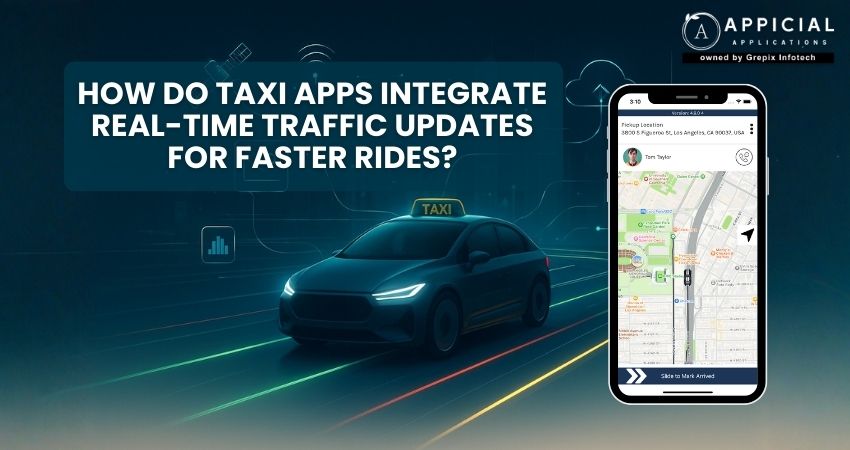
How Do Taxi Apps Integrate Real-Time Traffic Updates for Faster Rides?
Urban mobility depends on timing. Commuters expect accurate arrival estimates, and drivers rely on steady trip volumes. But city roads are unpredictable. Congestion, road closures, and weather changes can disrupt even the best-laid plans.
That’s where real-time traffic integration becomes crucial. A modern ride-sharing app collects continuous traffic feeds from GPS devices, mobile sensors, and mapping APIs. The app’s system reads these data points in seconds and updates routes automatically.
According to Statista, over 65% of global ride-hailing users list “accurate ETA” as their top priority when booking a ride. That expectation pushes every taxi app development company to focus on smarter routing and better data processing.
In today’s mobility ecosystem, this isn’t an optional feature; it’s the foundation of reliability.
The world of on-demand mobility thrives on speed and accuracy. When traffic conditions shift suddenly, even a minute of delay can affect rider satisfaction and driver income. Modern taxi apps now depend on real-time traffic intelligence to make instant route adjustments, reduce waiting times, and ensure predictable arrivals. This blog explores how ride-sharing apps use live data to stay efficient, how this technology works, and why companies like Appicial Applications are helping startups implement it at scale.
Where Taxi Apps Source Their Traffic Data?
A white-label taxi booking app doesn’t build its own traffic infrastructure. Instead, it connects to specialized providers. These data come from several major sources that work together in real time:
- GPS Telemetry: Each driver’s phone constantly sends signals about speed and location. Aggregated across thousands of vehicles, this information reveals live road flow.
- Navigation APIs: Platforms such as Google Maps, Mapbox, and Here Technologies supply congestion heatmaps and incident alerts.
- Government Data: Many cities share open traffic data that developers can integrate into their systems.
By combining these inputs, the app builds an accurate snapshot of city movement. A white label taxi app development company handles these integrations using APIs and server-side analytics so that the ride remains smooth even when conditions change mid-trip.
Still, the data itself is only useful when analyzed intelligently and that’s where AI enters the picture.
The Role of AI and Machine Learning in Traffic Integration
Artificial Intelligence and Machine Learning are the engines behind modern route optimization. They interpret the chaos of urban traffic in real time.
Here’s what happens behind the scenes:
- The app collects thousands of signals about road speed, congestion, and driver patterns.
- The AI model compares this data with historical trends.
- It predicts which roads are likely to slow down and adjusts the route accordingly.
This constant recalibration allows the app to make small changes before delays occur. McKinsey’s mobility report (2024) estimates that AI-driven navigation can reduce travel time by up to 25% in high-traffic regions.
For startups, partnering with a taxi app development company that already embeds AI modules into its Uber Clone platform saves months of research and development. It means faster time-to-market and more reliable app performance from day one.
How Real-Time Traffic Enhances ETA Accuracy?
Passengers don’t see code or algorithms; they see the clock. When the app promises a 10-minute arrival, they expect accuracy.
Without real-time traffic data, these estimates can quickly become outdated. Congestion, detours, or accidents can easily add several minutes to a trip. With live updates, the system recalculates ETAs every few seconds, adjusting based on driver speed and route density.
According to Deloitte’s 2024 Mobility Survey, taxi platforms with dynamic ETA recalculations enjoy 21% higher customer retention compared to those with static predictions.
Accuracy builds trust. And trust builds loyalty. Every ride-sharing app that consistently meets its ETA strengthens its reputation in a competitive marketplace.
That reliability is one reason many new operators choose a white label taxi app development company, the live traffic layer is already part of the framework, tested and refined over multiple deployments.
Mapping APIs
Mapping APIs make it possible for taxi apps to visualize routes and traffic conditions in real time. These APIs handle everything from basic map rendering to advanced predictive traffic modeling.
The most widely used include:
- Google Maps Platform: Combines global map data with continuous traffic updates.
- Here Maps API: Offers precise travel-time prediction based on historic congestion.
- Mapbox Navigation SDK: Allows deeper customization for white-label solutions.
A white-label taxi booking app often integrates two or more APIs for redundancy. This ensures accuracy even when one data source becomes temporarily unreliable.
A specialized taxi app development company manages these connections securely, ensuring smooth performance and minimal data lag. Appicial Applications, for instance, uses adaptive API selection so each app instance always relies on the most accurate feed available in its location.
The Cloud Infrastructure Behind Real-Time Processing
Handling live traffic data requires robust cloud architecture. Every second, thousands of data packets move between the driver’s app, the central server, and the rider’s interface.
Modern Uber Clone solutions rely on distributed cloud platforms like AWS, Google Cloud, or Microsoft Azure. These systems allow real-time data streaming with low latency.
Cloud servers manage:
- Routing calculations
- Data synchronization
- Load balancing during peak hours
Because the backend is scalable, the app can handle more requests during rush hours without slowing down. For startups, this means they can expand across cities without rebuilding infrastructure, a major benefit of working with a white label taxi app development company.
Predictive Analytics and Proactive Routing
Real-time data shows what’s happening now. Predictive analytics estimates what will happen next.
Taxi apps now combine both. They not only reroute drivers around congestion but also anticipate where traffic will form in the next 15–30 minutes.
By analyzing past data, event schedules, and even weather conditions, the system forecasts possible slowdowns. Then, it directs drivers to alternative paths before congestion begins.
A ride-sharing app using predictive modeling can reduce idle time by up to 20%, according to Accenture’s 2023 mobility insights report. This predictive logic also helps dispatchers allocate vehicles better; fewer cars stuck in one area means faster pickup times everywhere.
Such forward-looking capability is why most taxi app development companies integrate analytics engines into their white-label taxi booking apps from the start.
The Impact on Drivers and Operations
Real-time routing isn’t only about riders; it’s also about driver efficiency.
Drivers benefit from shorter routes, less fuel consumption, and more completed trips per shift. Fleet operators can track performance, adjust driver assignments, and reduce downtime.
Statista (2024) reports that ride-hailing drivers using apps with traffic-based dispatch complete 18–22% more trips per day than those without it.
Operational dashboards built by a white label taxi app development company convert raw traffic data into insights. Managers can see congestion zones, monitor live heatmaps, and shift driver supply in real time.
This type of optimization turns small efficiency gains into measurable business advantages.
Learn More: What Are the Most Innovative Features in Taxi Apps Available in South Africa?
How Real-Time Traffic Integration Improves Sustainability
Smarter routing reduces fuel use and emissions. For every minute a driver avoids idling, the app saves both fuel and carbon output.
According to IEA’s 2024 Global Transport Report, improved route efficiency in ride-hailing platforms can cut CO₂ emissions by up to 12% annually in major cities.
Many platforms now use this data to display eco-metrics, showing riders how much pollution was avoided by choosing optimized routes. For startups, building sustainability into their model isn’t just ethical; it’s a brand advantage.
That’s why Appicial Applications integrates route-efficiency modules in every Uber Clone it develops. Each white-label taxi booking app comes with reporting tools that help businesses monitor their environmental performance over time.
Why Partnering with Appicial Applications Matters?
In a market defined by speed and technology, not every startup can afford long development cycles. That’s where Appicial Applications becomes invaluable.
As a trusted taxi app development company, Appicial delivers end-to-end platforms that include live traffic integration, AI-based dispatch, and predictive analytics. Its white-label taxi booking app framework allows entrepreneurs to launch fully operational systems in a matter of weeks.
Key strengths include:
- Faster deployment with pre-tested features
- Scalable architecture for growth across cities
- Integrated mapping APIs with real-time traffic and routing
- Custom branding and localization for each market
Each Uber Clone solution is designed for stability, accuracy, and long-term growth.
If you’re building a new ride-sharing app, Appicial ensures your platform is not only functional but also future-ready, capable of adapting to evolving traffic technologies and user expectations.
Conclusion
The ability to process real-time traffic data has redefined what it means to be an efficient taxi app. From AI-powered routing to predictive analytics and sustainability tracking, these technologies ensure smoother rides and better outcomes for both passengers and drivers.
For startups entering this fast-moving market, the choice of technology partner makes all the difference. Appicial Applications stands out as a reliable white label taxi app development company, offering intelligent, scalable, and customizable white-label taxi booking apps built for modern cities.
If your goal is to launch a responsive, data-driven Uber Clone, don’t start from scratch. Contact Appicial Applications today to develop a robust, real-time-enabled ride-sharing app that delivers faster rides and smarter performance, right from day one.
FAQs
Author's Bio

Vinay Jain is the Founder at Grepix Infotech and brings over 12 years of entrepreneurial experience. His focus revolves around software & business development and customer satisfaction.
Back to blog list