
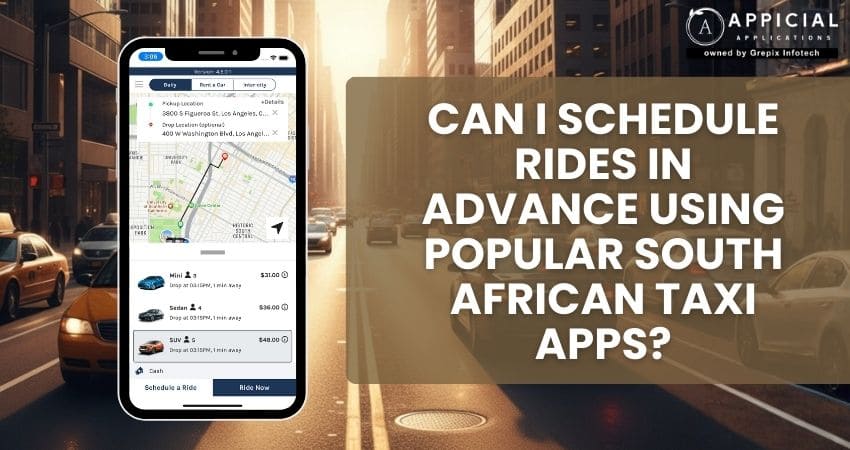
Can I Schedule Rides in Advance Using Popular South African Taxi Apps?
In the era of digital mobility, knowing whether you can book a ride in advance is a key convenience factor. For users in South Africa, the question is very much relevant: can you schedule your ride in advance on the well-known ride-hailing platforms operating in the country?
In this blog, we examine the situation within South Africa’s e-hailing market, document how scheduling features work among major apps, highlight important considerations and outline how businesses can build or adopt their own ride-sharing platforms via a reliable Uber Clone or white-label taxi booking app solution provided by a reputable taxi app development company.
We begin by examining the context of ride-hailing in South Africa, then inspect the scheduling functionality, discuss the benefits and limitations, and finally address how entrepreneurs or mobility providers can capitalise on the trend via a ride-sharing app.
This blog explored whether you can schedule rides in advance using the top ride-hailing apps in South Africa. The answer: yes, especially with Uber Reserve. It detailed how scheduling works, the benefits and limitations, and tied this into the broader ride-sharing market context. For mobility businesses and entrepreneurs, we outlined why scheduling is now a core feature in a ride-sharing app and how deploying a white-label taxi booking app via a taxi app development company can fast-track your platform launch. In a growing e-hailing market, offering scheduling can differentiate your service.
What is the ride-hailing landscape in South Africa?
South Africa’s e-hailing or ride-sharing market is experiencing significant growth.
According to one market forecast, the South African e-hailing market size is projected to increase from approximately US $1,380 million in 2025 to about US $3,084.7 million in 2030, at a compound annual growth rate (CAGR) of 17.45%.
This rapid expansion is driven by wide smartphone adoption, urbanisation, tourism and improved regulatory frameworks that now more explicitly recognise e-hailing services.
Furthermore, insights show that the majority of ridesharing app users in South Africa fall in the 25-34 age group (66.4 %) and 18-24 age group (27.8 %).
With this background, the deployment of features such as ride scheduling becomes an incremental but important step in user experience maturity.
Do South African taxi apps allow advance bookings of rides?
Yes. Among the major players in South Africa, scheduling a ride in advance is available. For example, the global platform Uber operates in South Africa and offers the “Reserve” feature that allows users to book up to 90 days in advance.
When you open the Uber app in South Africa, you can select the 'Reserve' option, input your preferred time and date, pick your ride type and lock in the pickup. The feature is aimed at business trips, travel to the airport, scheduled events, and other situations where knowing a ride is ready is valuable.
In South Africa, the blog from Uber states: “Request a ride up to 90 days in advance at any time of the day. Make sure to book a Reserve trip more than two hours prior to your departure to access the full benefits of the trip.”
Thus, for Uber, scheduling in advance is definitely supported in South Africa.
It is worth noting that scheduling features may vary by city and ride type. For instance, Uber’s help centre indicates that for some markets, scheduling is possible 30 minutes to 30 days ahead.
Other ride-sharing apps active in South Africa, such as inDrive and Bolt, also operate, though publicly available documentation on their advance-booking features in South Africa is less detailed. InDrive, for example, has been noted for innovative data-zero-rating deals for South African users.
Therefore, if you intend to schedule rides in advance in South Africa, the answer is yes — at least for some major apps like Uber — with the caveats about availability, city/ride type and cancellation policies.
How does scheduling a ride in advance work in practice?
When you use a scheduling feature such as Uber’s “Reserve”, a few steps and considerations apply:
- Select your pickup date and time: You open the app, pick the “Reserve” or “Schedule” option, then select date and time, select pickup and destination.
- Fare estimate up-front: The platform shows an estimate of the fare and locks in the price (depending on region). For example, Uber states the upfront price may change if stops are added or a route is significantly altered.
- Confirmation and driver assignment: In many cases, you will receive confirmation that your ride is scheduled. A driver is assigned nearer the pickup time. As Uber notes: “The driver who accepts your ride request may arrive at your pickup location at any time within your 10-minute window.”
- Pickup wait time: With scheduled rides, you may receive additional wait time built into the rate, to give flexibility. For example, Uber’s Reserve mentions the driver will wait five minutes after the scheduled pick-up.
- Cancellation policies: Scheduled rides may carry stricter cancellation rules. For example, Uber Reserve in South Africa may charge a cancellation fee if you cancel less than 60 minutes before pickup.
- City/availability limitations: Not all ride types or cities may support scheduling. Uber notes Reserve is “available in select cities.”
By understanding these mechanics, users can effectively schedule rides ahead of time, and businesses considering building or deploying ride-sharing platforms can embed similar logic in their features.
What are the benefits of scheduling rides ahead?
The ability to schedule rides in advance offers multiple benefits for users, drivers and platform providers:
- Peace of mind and planning: Knowing the ride is booked ahead reduces stress for key transfers (airport, early flights, business meetings). Uber highlights this as a core benefit.
- Avoiding peak demand uncertainty: If you schedule ahead, you may avoid surge pricing or reachability issues during peak demand. For instance, Uber states you lock in a price with Reserve.
- Better utilisation for drivers: From the driver or platform perspective, scheduling allows better anticipation of demand and potential optimisation of fleet deployment.
- Enhancing service offerings: For a ride-sharing app or white-label taxi booking app, offering scheduling elevates the user experience and opens higher-value segments (corporate, events, airport transfers).
- Competitive differentiation: In a market such as South Africa, where traditional metered taxis are challenged, ride-sharing apps with scheduling features become more attractive. Research shows app-based ride services are disrupting metered taxi models.
Thus, scheduling is a valuable feature for both end-users and mobility platforms.
What are the limitations and things to watch out for?
Despite the advantages, there are important limitations and caveats when scheduling rides in advance:
- No absolute guarantee of driver availability: Even with a scheduled ride, the platform may not guarantee a driver will accept the trip. As Uber states, “Uber doesn’t guarantee that a driver will accept your ride request. Your ride is confirmed once you receive your driver details.”
- Cancellation and change penalties: Scheduled rides often have stricter cancellation terms or fees. For example, in South Africa, Uber Reserve charges a cancellation fee if you cancel within 60 minutes.
- City, vehicle-type or ride-type limitations: Availability of scheduling may be restricted to certain cities or ride categories (premium vs economy) and may exclude pickups at airport zones.
- Demand-based pricing movement: While upfront pricing is provided, changes in route, added stops or unforeseen tolls may still alter the cost.
- User readiness: Because the driver may arrive within a time window (e.g., 10 minutes), users must be ready and at the pickup location. If not, the driver might cancel after five minutes.
- Regulatory and market risks: In the South African context, traditional taxi industry tensions, regulatory oversight and driver-licensing issues can affect reliability.
Therefore, users should treat scheduling as enhanced convenience, but still retain contingency plans. Providers building services should aim to mitigate these risks.
How does this relate to building your own ride-sharing or taxi app?
For mobility entrepreneurs, fleet operators or service providers, the existence of scheduling features among leading apps signals what modern users expect. If you are exploring launching your own ride-sharing app, a robust scheduling capability should be part of the feature-set. In this context, you may leverage an Uber Clone or a white-label taxi booking app offered by a taxi app development company.
Key considerations when selecting or building such a solution include:
- Scheduling module: The platform should allow users to pick date/time, set pickup details, confirm, track status and manage cancellations.
- User interface and UX: The scheduling icon, calendar/time picker, upfront fare estimate and upcoming trips list should be intuitive, mirroring best-practice from top apps like Uber.
- Driver app integration: Drivers must receive scheduled ride notifications ahead of the event, see pickup windows, and have ETA tracking.
- Back-end system logic: The system must handle availability, dynamic driver allocation, cancellation policy enforcement, surge management and notifications.
- Billing/pricing engine: Up-front fare locking, time-based or window-based wait time, cancellation fee logic all need implementation.
- Localisation and compliance: If operating in South Africa or elsewhere, the app must align with local regulations, payment methods and mapping/integration needs.
Choosing a reputable taxi app development company with experience in mobility solutions can significantly reduce time-to-market. They may offer a ready-to-deploy white-label taxi booking app that supports scheduling, real-time tracking, ratings, payment integration and admin dashboards. The term “white-label” means you can brand it to your business without rebuilding from scratch.
Moreover, using an Uber Clone script can accelerate launch, but you must still ensure it is customised, secure and market-ready. With scheduling becoming a standard expectation, skipping this feature may place your service at a competitive disadvantage.
Learn More: Which Taxi App Offers the Best Advanced Booking Options Here?
What should riders and fleet operators in South Africa keep in mind?
For riders in South Africa wanting to schedule rides:
- Confirm the pick-up city and vehicle category support scheduling.
- Book at least two hours (or as recommended) ahead if using Uber Reserve.
- Check cancellation terms: late cancellation may incur fees.
- Be ready at pickup within the window; failure may result in driver cancellation.
For fleet operators, taxi businesses or mobility providers considering entering this space:
- Study major app functionality and user expectations (advance booking, wait time, upfront pricing).
- If you build your own ride-sharing app, ensure scheduling is part of the feature set and is stable.
- Engagement with a quality taxi app development company will ensure that scheduling logic, driver workflow and payment modules are built correctly.
- Consider implementing scheduling as a value-added service for corporate clients, airport transfers or event logistics.
- Build marketing messaging around reliability, advance booking and driver allocation—features that may differentiate your service from standard street-hailing.
With the market in South Africa growing strongly, equipping your service with scheduling functionality could provide a strategic advantage.
Conclusion
To answer the question, yes, you can book rides in advance using popular South African taxi apps. For example, Uber has this feature in South Africa, where a user can reserve a ride 90 days in advance of when they need it. There are limitations (available by city, cancellation policies, no guarantee an accepted driver will show up), but the schedule feature is indicative of an increasing maturation of the ridehailing ecosystem. For riders, this translates to improved convenience and planning. The takeaway for businesses, fleets and mobility entrepreneurs is that there is no longer an option to provide the ability to schedule; it is now a requirement.
If you’ve been toying with the idea of starting your own ride-hailing company, now is your moment. Hire an experienced taxi application development company to launch your white-labeled taxi booking application or Uber Clone complete with scheduling, bookings, driver management and ease of use. Given the potential growth of the e-hailing market in South Africa, there is a lot of opportunity for your platform to provide value and also attract users by having a solid scheduling module.
Have a great idea for a ride-share app with advance scheduling? Get in touch with us today and see how our white label taxi booking app solutions along with the taxi app development company expertise can help you launch in no time! Book a free consultation today, and we will get your rideshare business rolling.
FAQs
Author's Bio

Vinay Jain is the Founder at Grepix Infotech and brings over 12 years of entrepreneurial experience. His focus revolves around software & business development and customer satisfaction.
Back to blog list