
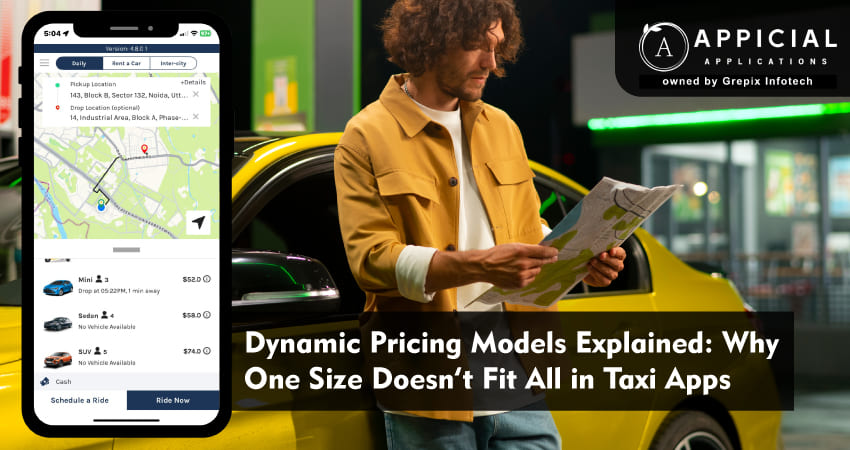
Dynamic Pricing Models Explained: Why One Size Doesn’t Fit All in Taxi Apps
In the competitive and evolving mobility sector, one-size-fits-all fixed pricing models are increasingly inadequate. Modern consumers expect responsiveness. Drivers need incentives. Platforms require profitability and flexibility. For a ride-hailing app or ride-sharing app, adopting a dynamic pricing model is no longer optional; it is essential.
The concept of an Uber Clone or white label taxi booking app must incorporate flexible fare mechanisms to respond to real-time variables. A capable taxi app development company or white label taxi app development company will emphasise that pricing is a core functional pillar.
In this blog, we delve into why dynamic pricing matters, the models available, how to implement them properly, and why “one size” simply fails at building a sustainable mobility business.
In this detailed blog, we examine why dynamic pricing models have become critical for modern taxi mobility platforms. We explain the limitations of one-size-fits-all fixed-price models in the context of a ride-hailing app or ride-sharing app. We explore how shifts in supply and demand, geography, time of day, weather, local events, and other variables force companies to adopt dynamic pricing. We discuss different models (surge, time-based, zone-based), how algorithms work, the challenges (transparency, customer perception, regulation) and best practices in implementation. Then we highlight the role of a proficient taxi app development company, or a white-label taxi app development company, in enabling these features in your Uber Clone or white-label taxi booking app.
Why Does Pricing Need to Be Dynamic in Taxi Apps?
What variables influence ride demand and driver supply?
In a ride-hailing app, numerous external factors affect both supply and demand. Time of day, day of week, weather conditions, local events (concerts, sports), traffic congestion, airport arrivals, all change demand patterns. On the supply side, driver availability, zoning restrictions, fuel cost, vehicle type and idle driver hours vary. Research has found that dynamic pricing helps platforms manage these fluctuations by aligning incentives and availability. A fixed fare ignores these dynamics and can lead to supply shortages (no driver available) or inefficiencies (drivers idle in low-demand zones).
Why does one size not fit all in fare models?
A flat fare model simply cannot accommodate the complex nature of urban mobility. For example, a ride at midnight in a suburban area with few drivers may cost the same as a midday ride in a central zone, yet the cost, risk and driver idle time differ markedly. A successful white-label taxi booking app must recognise that different zones, times, and conditions require differentiated pricing. According to academic modelling, static pricing throughout a large network underutilises resources and reduces revenue potential. This reinforces why a taxi app development company designing your platform must include dynamic pricing logic from day one.
How does dynamic pricing help balance the marketplace?
When demand outstrips supply, fares can increase to encourage more drivers to service that area, reducing wait times and improving user experience. Conversely, during slack periods, prices may drop or promotions may apply to stimulate usage. This balancing act ensures that a ride sharing app can maintain reliability and efficiency. A 2022 study on taxi driver behaviour found that introducing dynamic pricing increased labor supply by roughly 5.1% in certain markets. Thus, dynamic pricing is a crucial tool for platform equilibrium.
What Types of Dynamic Pricing Models Exist in Taxi Apps?
Surge or Peak Pricing Model
This model increases fares when demand spikes relative to available drivers. It is the most well-known form in a ride hailing app. For example, during heavy rain or a large event, fares surge to reflect the higher cost of fulfilling rides. A blog on taxi app profitability emphasises that surge pricing is pivotal for white label taxi booking apps to remain profitable in unpredictable conditions. However, the taxi app development company must build transparency features so users understand why the fare is higher.
Time-based and Zone-based Pricing
In more advanced systems, fares vary by time slot or zone. For example, rides from suburban edges after midnight may cost more than downtown daytime rides. According to research from the Fuqua School of Business, static pricing may suffice between high-density hubs, but flexible pricing is required for “spokes” or peripheral zones. A ride-sharing app or e-hailing app developer must map demand-supply by zone/time and incorporate differential pricing logic.
Event-based and Contextual Pricing
This model incorporates external events, concerts, sports matches, and weather disruptions that cause demand deviations. In an Uber Clone, the algorithm may detect a stadium finishing time, apply a geo-fence for surge, and notify users accordingly. A white label taxi app development company must integrate event feeds and real-time data to enable contextual dynamic pricing. According to a recent review, these contextual variables are increasingly used to optimise ride-hailing profitability.
Incentive-Based Pricing for Drivers
Dynamic pricing not only impacts riders. It can incentivise drivers to work at certain times or zones. The referenced Singapore study found drivers reallocated to less served areas and rush hours when dynamic pricing was applied. A ride-hailing app must align driver incentives, ensuring the supply side is engaged when demand is highest.
What Benefits Do Dynamic Pricing Models Deliver for Taxi Apps?
Enhanced Revenue and Profitability
Using dynamic pricing, a white-label taxi booking app can increase per-ride revenue during peak times, capture latent willingness to pay, and optimise resource use. A review article states that dynamic pricing is “a pivotal strategy for taxi apps … crucial for maximizing profits while balancing demand and supply.” Given that the global ride-hailing market is projected to grow to hundreds of billions of USD, these incremental gains matter.
Better Resource Allocation and Reduced Wait Time
By encouraging drivers to move to high-demand zones via pricing signals, a ride-sharing app improves availability and reduces wait times. This improves user satisfaction and retention. A paper found that dynamic pricing helps clear previously unserved areas and rebalances supply. When driver supply aligns proactively with demand, the platform becomes more efficient.
Improved Platform Efficiency and Supply Management
The complexity of matching drivers and riders can be addressed via pricing mechanisms. The algorithmic model cited by Fuqua researchers suggests that cars across the network must be treated as distributed resources. A robust taxi app development company will embed such resource-aware pricing logic to maximise throughput and minimise idle vehicle hours.
Competitive Differentiation for an Uber Clone
An Uber Clone or white label taxi booking app that incorporates dynamic pricing intelligently stands stronger in competitive markets. Static fare apps may appear cheaper sometimes, but will struggle with reliability and driver availability. Dynamic pricing gives the edge in market responsiveness, user trust, and margin control.
What Challenges and Risks Come with Dynamic Pricing?
Perceptions of Unfairness or Exploitation
While dynamic pricing is operationally sound, many users view it as unfair when fares surge significantly. Transparent communication is essential. A review article warns of customer-perception issues with surge pricing. If a ride-hailing app or ride-sharing app fails to explain why pricing increased, it risks backlash and brand damage.
Regulatory Constraints and Legal Risks
In many jurisdictions, dynamic pricing is regulated or even restricted. For instance, some authorities cap surge multipliers to protect consumers. A news piece reported new rules in India aimed at capping fees for app-based cabs. A white label taxi app development company must build configurable pricing rules to comply with local regulations.
Complexity of Algorithm Design and Data Requirements
Implementing dynamic pricing requires advanced data infrastructure: real-time demand/supply analytics, driver positioning, event detection, zone mapping, buffer controls and more. The Fuqua article emphasises the mathematical and resource-allocation complexity. A taxi app development company must integrate not just UI but deep backend algorithmic infrastructure.
Driver and Rider Trust and Retention Impacts
If drivers perceive pricing signals as inconsistent or unfair, they may lose trust in the platform. Similarly, riders who pay high fares during surges may abandon the app. Hence, a balance must be struck. A robust ride-sharing app will include driver transparency and rider incentives (discounts, loyalty) to manage perceptions.
Risk of Over-surge or Pricing Abuses
Unchecked dynamic pricing may escalate to unreasonable fare spikes. Platforms must cap surges, provide explanations, and offer alternate options. The academic review noted that poorly managed dynamic pricing can reduce welfare. A strategic Uber Clone must include safeguards.
How Should a Taxi App Development Company Approach Dynamic Pricing Implementation?
What architecture is required for dynamic pricing in a ride-hailing app?
When partnering with a taxi app development company or white label taxi app development company, ensure the architecture includes the following modules: demand/supply monitoring, zone/time/event detection, pricing engine (with real-time multiplier logic), driver incentive interface, rider display & warning of surge, analytics dashboard, regulatory rule engine (caps), fallback logic for assignment. The system must treat dynamic pricing as a core rather than an add-on.
What data sources and analytics must you include?
A ride-sharing app must ingest historical and real-time data: ride requests by time/zone, driver availability, cancellations, idle time, weather feeds, event calendars, traffic data, and local regulations. Without rich data, dynamic pricing becomes arbitrary. According to research, dynamic pricing requires both matching and pricing algorithms working in tandem. The ride-hailing app builder must integrate these feeds and analytics components.
How do you maintain transparency for riders and drivers?
Transparency is critical to avoid a perception of exploitation. The UI must show when the surge is active, estimated fares, reason (peak hour, event), and alternative options (wait till a lower price). A white label taxi booking app must include notification logic. Driver dashboards must show expected earnings and surge multipliers. A taxi app development company should prepare UX flows for both sides.
What regulatory compliance considerations should you build?
Local jurisdictions may cap fare multipliers, require disclosure of surges, or forbid certain surge practices. For example, one region capped surge to 1.5× base fare. Ensure the pricing engine is configurable for region-specific rules. A Uber Clone builder must make the system modular and compliant across geographies.
How do you test and iterate pricing performance?
Set up key performance indicators (KPIs) such as ride acceptance rate, driver supply ratio, average wait time, fare multiplier trends, and rider satisfaction. Run A/B tests for different multiplier thresholds, zone definitions, and time windows. A ride-hailing app must iterate. A hiring taxi app development company should build in analytics and dashboard tools.
How to roll out dynamic pricing in phases?
Launching dynamic pricing in one big go can risk chaos. Instead, the strategy may involve pilot zones, controlled multipliers, driver training, and rider communication. A white label taxi app development company will recommend phased roll-out: e.g., begin with airport rides or special events, then expand city-wide.
Which Pricing Strategy Should You Adopt?
Should you apply the same fare multiplier across all zones and times?
No. Using a uniform multiplier ignores demand and supply heterogeneity. According to algorithmic research, hubs may be priced statically, but spokes require dynamic pricing. Thus, your ride-hailing app should tailor multipliers by zone and time segment.
How do you determine the base fare and the surge multiplier logic?
Determine base fare considering cost drivers (vehicle, fuel, driver pay, overhead). Then apply surge logic when the demand/supply threshold is crossed. A ride-sharing app should use historical data to set thresholds. A taxi app development company will build an engine that monitors real-time ratios and triggers a surge when driver availability falls below, say, X % of demand.
Is it better to inform riders of surge early or only at confirmation?
Better to inform early. Transparency increases trust and reduces cancellation. A white-label taxi booking app developer should include a UI element that states, “Fare may be higher because of high demand.” This reduces negative perception and supports user retention.
How to treat driver incentives during dynamic pricing?
Driver incentives may include higher earnings, bonuses for servicing surge areas, or guaranteed minimum fares. A ride-hailing app should clearly display expected earnings before acceptance. The algorithm should optimise driver supply by offering incentives to underserved zones. A taxi app development company will integrate this logic into driver dashboards.
Also Read: How Fare Estimation Improves Transparency in Ride-Hailing Apps
How frequently should you review and adjust the pricing model?
Regular reviews are essential. Weekly or monthly analyses of surge multipliers, user cancellation rates, driver acceptance rates, and market feedback are key. A ride-sharing app should iterate. The taxi app development company must build metrics tracking and dashboards for this continuous improvement.
Can you combine fixed and dynamic pricing in one platform?
Yes. A hybrid model may use fixed fares for standard zones/times and dynamic pricing only for peak, special zones or events. For example, base daytime downtown rides may remain fixed while late-night suburban rides use surge. An Uber Clone built by a robust white-label taxi app development company can support both modes and switch seamlessly between them.
Why Partnering with Appicial Applications Makes the Difference
When you plan to launch or upgrade a ride-hailing app, ride-sharing app, or e-hailing app, the choice of development partner is critical, especially when dynamic pricing is part of your value proposition. Here’s why partnering with Appicial Applications gives you the edge:
- Appicial Applications specialises in creating scalable and feature-rich Uber Clone and white label taxi booking app solutions.
- They act as a full-service taxi app development company and white label taxi app development company, covering architecture, driver and rider apps, admin panels, dynamic pricing engines, and analytics dashboards.
- When your business model depends on sophisticated pricing, Appicial’s team brings a deep understanding of ride-sharing app economics, supply-demand dynamics, zone/time modelling, and driver-rider incentive design.
- Their modular architecture supports variant pricing models, surge, zone-based, event-based, fixed + dynamic hybrid. This means your ride-hailing app never has to compromise on pricing flexibility.
- They build configurable rule engines for compliance, transparency features for user trust, and analytics modules so you can monitor KPIs and iterate.
- With Appicial, you get a future-proof white label taxi booking app where dynamic pricing is not bolted on but baked in from day one.
- Their post-launch support and optimisation services ensure your platform evolves as demand patterns change.
Ready to build a high-performance Uber Clone or ride-hailing app with built-in dynamic pricing capabilities? Contact Appicial Applications today for a free consultation and demo. Let’s unlock flexible, reliable fare models that suit your market and scale sustainably.
Conclusion
In summary, dynamic pricing models are no longer optional for mobility platforms; they are foundational to competitive success. A ride-sharing app, ride-hailing app, or e-hailing app that uses a static fare model across all times, zones and conditions is missing out on efficiency, profitability and reliability. Different zone dynamics, time slots, events, driver availability and traffic patterns mean that one size doesn’t fit all. By implementing zone/time/event-based pricing, surge logic, driver incentives, and transparency, platforms can optimise resource usage, enhance rider satisfaction and improve margins.
However, the design and execution of these pricing models are complex: advanced algorithms, real-time data, regulatory compliance and driver behaviour all matter. A competent taxi app development company or white label taxi app development company will integrate these features seamlessly in your Uber Clone or white label taxi booking app.
With Appicial Applications as your partner, you can build a scalable, flexible and future-ready mobility platform where pricing logic is a strategic asset, not a liability. Don’t settle for generic fare models. Move ahead with a pricing engine engineered for agility and growth.
FAQs
Author's Bio

Vinay Jain is the Founder at Grepix Infotech and brings over 12 years of entrepreneurial experience. His focus revolves around software & business development and customer satisfaction.
Back to blog list